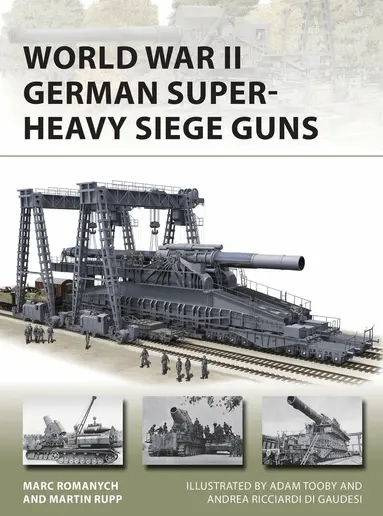
World War II German Super-Heavy Siege Guns
- Vikt 0,2 kg
161 krhos Bokus · exkl. frakt
48 kr skillnad mellan billigaste och dyraste butik i lager
Dubbelkollade priser
Jämför 4 butiker
- Bokus, 161 kr, frakt enligt butiken. Till butik (öppnas i ny flik)
I lagerFrakt: se butikenDubbelkollad 10:51
161 kr
Lägst
- Akademibokhandeln, 209 kr, frakt enligt butiken. Till butik (öppnas i ny flik)
I lagerFrakt: se butikenDubbelkollad 09:53
209 kr
- Buyersclub, 169 kr, frakt enligt butiken. Till butik (öppnas i ny flik)
Slut i lagerFrakt: se butikenDubbelkollad 05:34
169 kr
- Adlibris, 195 kr plus 35 kr frakt. Till butik (öppnas i ny flik)
Slut i lagerFrakt 35 krDubbelkollad 27 okt. 09:10
195 kr



Priser från butikernas flöden kan ha ändrats: det är priset hos butiken som gäller, så kontrollera det innan du handlar.
Prishistorik
Köp nu eller vänta?
Just nu kostar produkten 161 kr — 2 kr över det lägsta vi sett på 1 månad.
Under den tiden har det oftast legat runt 160 kr.
Pris idag
161 kr
- Lägst
- 159 kr
- Snitt
- 160 kr
- Högst
- 162 kr
| 2026-09-15 | 161 kr · Lägst hos Bokus |
|---|---|
| 2026-09-17 | 159 kr · Lägst hos Bokus |
| 2026-10-02 | 160 kr · Lägst hos Bokus |
| 2026-10-06 | 161 kr · Lägst hos Bokus |
| 2026-10-08 | 162 kr · Lägst hos Bokus |
| 2026-10-12 | 161 kr · Lägst hos Bokus |
| 2026-10-16 | 162 kr · Lägst hos Bokus |
| 2026-10-17 | 161 kr · Lägst hos Bokus |
Om produkten
World War II German Super-Heavy Siege Guns
Läs merLäs mindre
As the outbreak of World War II approached, Nazi Germany ordered artillery manufacturers Krupp and Rheimetall-Borsig to build several super-heavy siege guns, vital to smash through French and Belgian fortresses that stood in the way of the Blitzkrieg.These 'secret weapons' were much larger than the siege artillery of World War I and included the largest artillery piece of the war, the massive 80cm railway gun 'schwere Gustav' (Heavy Gustav). However, these complex and massive artillery pieces required years to build and test and, as war drew near, the German High Command hastily brought several WWI-era heavy artillery pieces back into service and then purchased, and later confiscated, a large number of Czech Skoda mortars. The new super siege guns began entering service in time for the invasion of Russia, notably participating in the attack on the fortress of Brest-Litovsk. The highpoint for the siege artillery was the siege of Sevastopol in the summer of 1942, which saw the largest concentration of siege guns in the war. Afterwards, when Germany was on the defensive in the second half of 1943, the utility of the guns was greatly diminished, and they were employed in a piecemeal and sporadic fashion on both the Eastern and Western Fronts. In total, the German Army used some 50 siege guns during World War II, far more than the thirty-five it had during World War I. Supported by contemporary photographs and detailed artwork of the guns and their components, this is an essential guide to these guns, exploring their history, development, and deployment in stunning detail.
Specifikationer
Fakta
- Vikt
- 0,2 kg
- GTIN
- 09781472837172
Uppgifter från tillverkare och butiker.